Oriyarasoi is on twitter !

Monday, February 28, 2022

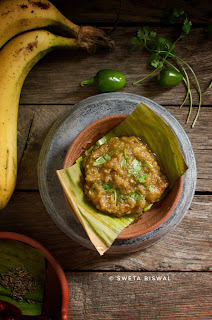
Jujube Pickle ( Koli Achara)


As grandma's little helper, one of the most coveted tasks was helping her get the jujubes prepped for making the pickle every year. Kilos of Jujubes would be washed, sorted, cracked open to check for infestation, and left in the sun for 2-3 days during which the stock would diminish exponentially.  At the best, only a quarter of it made into the pickle jars. The jars were themselves cleaned out in record time. Only a minuscule quantity would remain hidden by my grandmother and we would wait for it to be miraculously taken out once in a while. While we kids always denied our involvement in the mystery of the disappearing jujubes, all the gluttony left its tell-tale signs in the form of stomach upsets and persistent coughs. 

As a result, we were often suspended from guard duties and the jujubes would be sun-dried only when we were away in school. But the tantalizing smell of ripe jujubes is something that is hard to miss. And we kids would always sniff out the hidden stash and devour them. Over the years, the number of pickles being made at home decreased. And so did the quantities. I myself did not miss them much as I rarely had them.

Then came the lockdown and suddenly pickles were back on the plates. With veggies in short supply, pickles, and papads filled in the gaps. I found out that I quite enjoyed the process of making pickles, especially the quick ones. Sharing one of my favorites - 

Jujube Pickle 

Ingredients -

  • 750 gm of jujube
  • A lemon sized ball of tamarind
  • 200 gm jaggery
  • 1 tbsp of fennel seeds
  • 1 tsp of cumin seeds
  • 1/4 tsp fenugreek seeds
  • 3-4 dry red chilis
  • 1/2 tsp salt

Pre- Preparation - Wash and dry the jujube in the sun for a day or two. 

Remove the small stem sticking to the berries and crack them open to check for insect infestations. This also allows the seasoning to penetrate properly.

Allow the jujube to dry for another day in the sun.

Preparation - Soak a lemon-sized ball of tamarind in 1/2 cup water for 1 hour. Smash the tamarind and strain the liquid. (Use the discarded solids to shine your brass/copperware.)

Dry roast 1 tbsp of fennel seeds, 1 tsp of cumin seeds, 1/4 tsp fenugreek seeds and 3-4 dry red chilis each separately till they turn aromatic. Allow to cool down completely before grinding into a medium-fine powder which is sometimes referred to as the 'khatta masala' or the 'achara masala'. Each household has its own version.

Cooking - Heat a non-reactive saucepan and remember to keep the flame low. Add the tamarind extract. Allow it to come to a boil before adding 200 gms of jaggery and salt as per taste. Once the bubbles start to appear, add 2 heaped cups of the partially dried jujube. 

The mixture will continue to froth and foam for some time before starting to acquire a stringy consistency. At this stage, it needs to be stirred continuously.

Once the strings start getting thicker, add a tsp of the khatta masala. Mix for a minute or two before removing from the flame.

Allow to cool down completely before storing in a glass jar. The shelf life of this pickle is directly proportional to one's willpower but it lasts about 6-8 months when stored in an airtight jar in a cool dry place.

Now, for a zero waste recipe that one will need to use up the bits sticking to the saucepan. I personally find it too flavourful to be wasted.

Once you have transferred the jujube pickle to a jar, add half a cup of hot water to the saucepan to dissolve the jaggery and spices sticking to it. I usually leave in 4-5 pieces of the pickled jujube for extra flavor.

Put another pan on the burner. Add a teaspoon of mustard oil.
Once it gets smoking, add 4 medium-sized tomatoes that have been washed and quartered. Saute on high for 2 mins.

Sprinkle salt and cover for 3-4 mins on low flame. Open the lid and mash the tomatoes with a heavy spatula or spoon. 

Once tomatoes are mushy, transfer them to the other saucepan in which you made the jujube pickle. Turn the flame to medium and cook the mixture till the sauce thickens.

Taste the sauce and adjust the salt/jaggery/seasoning as required. Switch off the flame.

In another wok, add 1-2 teaspoons of mustard oil. Once it gets smoking, add 1/2 tsp pancha-phutana and broken dry red chili. Once the seeds stop spluttering, add a sprig of curry leaves. Pour it over the tomato khatta/chutney. 

Serve it with rice, roti, paratha or any other kind of Indian bread.

Note - This masala is also used to season the various kinds of 'Khatta' like Amba(mango) khatta, Sapuri(pineapple) khatta, Karamanga(starfruit) khatta, etc.


 

Wednesday, February 16, 2022

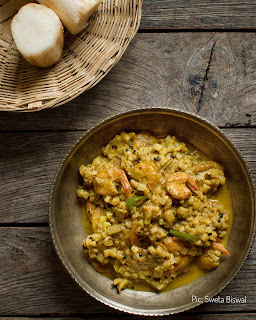
Chingudi Manja Besara ( Prawns cooked with banana stem)


'Too many mouths to feed'. A refrain I have often heard when documenting Odia recipes or even the processes involved in creating them. Ladies in such households often got creative with their cooking, devising unusual workarounds when a choice ingredient was in short supply. Such clever treatment was often reserved for ingredients that lay on the extreme ends of the desirability scale. For example, prawns or the head of a fish would be highly sought after while the tail or the innards of the fish would be mostly undesirable. Hence the recipes that centred around them evolved in response to the need of catering to each family member without the other one feeling discriminated. 

But as those sizable joint families succumbed to the vagaries of urban migration, they swallowed up an entire genre of recipes that were created to ensure each member got their share of the nutritional pie. It is an entirely different matter that such divisions often lacked equality and often called for the less privileged members of the household to supplement their meals with ingenious recipes that could be whipped up in a jiffy. The 'pagaw' as we collectively term them, comprises an array of dishes that have a distinct 'umami' element to them. And even a small portion of them is enough to elevate the most frugal meal.

I had a chance to cook a few such 'Jugaad' recipes last week at my in-law's place with inputs from my father-in-law. He had been expressing the desire to eat some of the dishes which were a staple during his childhood. While they cannot be classified as lost, they are no longer being cooked regularly in most Odia homes. Freshwater prawns cooked with tender banana stem and a smidgen of mustard paste is one such culinary gem that needs to be brought back into the public consciousness. It is sheer magic when a handful of prawns caught from a local water body meets an ingredient that was found in abundance in most Odia homes and never really sold in the markets. Mostly exchanged with relatives and neighbors as a goodwill gesture, the banana stem was always an important part of the retinue of vegetables that made up a regular meal. 

Chingudi Manja Besara


Freshwater prawns cooked with tender banana stem and a smidgen of mustard paste. The heat of the chili and the mustard balances out the inherent sweetness of the star ingredients. A whiff of mustard oil and a slight whiff of garlic add to the flavor profile. (never make the last two overpowering)

Ingredients
  • 1 cup finely chopped tender banana stem
  • 1/5 cup small prawns (cleaned)
  • 1 small tomato
  • 2 tsp mustard paste ( mustard seeds + garlic + green chili )
  • 2-3 green chili
  • 1-2 garlic clove 
  • 3 tsp mustard oil
  • 1/4 tsp mustard seeds
  • 1/4 tsp turmeric powder
  • salt to taste

Preparation 

Marinate cleaned prawns with salt and turmeric. 
Heat 2 tsp oil in a wok. Add the prawns and sauté them for 4-5 mins. Remove and keep aside.
Add the remaining oil to the wok. When hot, add mustard seeds, green chili, and crushed garlic. 

Add the chopped banana stem along with the mustard paste, turmeric, and salt. Cover and cook on low flame till the banana stem is almost done.
Add the prawns and cook for 2-3 mins. Drizzle a little mustard oil on top. Switch off the flame.

Serve after a couple of minutes with hot rice or Pakhala.

Thursday, January 6, 2022

Sukhua : Raising a stink in more ways than one


Relishing my bowl of Pakhala with a little Sukhau bhaja on the side, I grew up with scant knowledge of the universal nature of fish preservation. Aided by our own prejudices, Sukhua had turned into a forbidden word in many Odia homes. Cooking it on the sly was out of the question with the distinctive odor guaranteed to raise a stink with the neighbors. In fact, one's identity was entwined with the kind of preserved fish one ate. While our Balasore neighbors were known for their 'Íllishi sukhua', we were known to stock the 'Niya sukhua' or smoked fish that was procured from our native. In my mother's maternal home, winters were the time to stock up on Silamundi Sukhua from their favorite vendor. Over the decades, preferences shifted towards the fresh fish readily available in the markets, and the vendors selling 'Sukhua' gradually dwindled in numbers. And in the fast-paced life that we lead, most of us never questioned this abundance of fresh fish nor did we weigh the merits of fish preservation. This attitude has piggybacked on rising affluence and the notion that it gave one the privilege to waste food. 


Fish preservation itself dates back to ancient times. One of the oldest proof of fish preservation, which is quite difficult to pinpoint since the waste is thrown back into the sea or fed to animals, was discovered at Norje Sunnansund, an Early Mesolithic settlement site. The archaeological site of Norje Sunnansund is dated around 9,600 – 8,600 years before the present and is located in south-eastern Sweden. With climate playing a major role in the preservation techniques deployed across geographies, these Nordic folks resorted to preservation by wrapping up the fish and burying it underground to allow it to undergo a slow process of fermentation. 

Elsewhere, fishing communities inhabiting along the coastline would resort to salting and air drying their catch. Researchers have also found that the three main preparation techniques that prevail in today’s fishing communities, regardless of their geographic location –ventral gutting and dorsal cut (bony fish), and filleted straps of meat (sharks)– and that fish-body size influences which method is applied, were applicable in ancient times too. Not much has changed except for the use of hazardous preservatives, a deplorable practice that has seeped into commercial fish preservation. So, it is important to make sure where your stock of dried fish comes from.

A good sun-dried or smoked fish retains most of the protein content. It is rich in omega 3 fatty acids and antioxidants. A good source of protein, 100 grams of dry fish is made up of about 80 -85 percent of protein, and contains only about 300 calories. Sea fish especially has been a unique source of minerals like iodine, zinc, copper, selenium, and calcium. In the future, and in face of depleting marine reserves, striking a balance between dry fish supply and human nutritional needs is vital to support the health and well-being of the increasing human population. However, improving the hygiene levels and processes employed in fish drying is very much required if we have to eradicate the stigma associated with the consumption of dried fish. Especially since it is such a 'hands-on' ingredient when fresh ingredients are scarce or priced out of reach. I have been using it frequently during the lockdowns and found it to be one of the easiest ways to add the 'oomph' factor to our everyday meals.

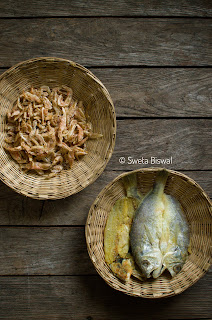
Sharing an easy and delicious dried shrimp recipe - 

Piaja Sandha Chingudi Sukhua


Ingredients -

  • 2 cups chopped onion flower stalks
  • 1 cup chopped baby potatoes
  • 2-3 tbsp tiny sundried shrimps
  • 2 dry red chilis
  • 1/2 tsp mustard seeds
  • 2 tsp mustard oil
  • 1/2 tsp salt
  • 1/3 tsp turmeric

Method

Soak the dried shrimps in water for half an hour. Drain and wash 2-3 times to get rid of sand and any dirt sticking to it. Squeeze out as much water as you can.

Heat the oil in a wok. Add the shrimp and fry on low flame till crisp, remove and keep aside.

Add the broken red chili and mustard seeds to the remaining oil. Add the chopped baby potatoes and cook for a few minutes before adding the onion flower stalks. Add salt and turmeric.

Cover and cook till the stalks soften up and the potatoes are cooked.

Finally, toss in the fried shrimps. Sauté for a minute before removing from the flame.

Serve with hot rice and dal.

Note - This dish tastes best in the winters when the potatoes are freshly harvested and the onion flower stalks are still tender. 


Monday, December 27, 2021

Mahaprasad: The Art and Science of Cooking


Much has been said about the Mahaprasad. The origin, the use of 'Óld World' ingredients, and age-old recipes, socio-cultural significance, and the spiritual journey. But hardly anyone talks about the 'cooking' itself. Ok, maybe an article or two mention something about the four kinds of ovens, the nine pots stacked one upon the other, or even the mystery of the ingredients in the topmost pot cooking faster than the ones below it. 

But cooking itself is a deeply spiritual activity. And the food is a metaphor for energy. We draw our life energy from food. Hence it becomes important that this energy, which gets stamped all over our food, is at its purest. A fact reiterated by the way food is cooked at the temple kitchen. And more so at Jagannath Puri, the 'Dham' or 'Divine dwelling' where Lord Vishnu is believed to take his meals which are cooked by his wife, Goddess Lakshmi. 

The rules are sacrosanct. The temple cooks or 'Suaras' have to take a bath and wear fresh clothes before venturing into the kitchen. In addition, they never enter the kitchen on an empty stomach. Quite a contrast when one superimposes this image with the that of sleepy folks stumbling into the kitchen in their nightclothes for cooking and packing a lunchbox. The difference in energies is striking. 

In addition to following the rules of hygiene, the 'Suaras', who are not permitted to grow beards or mustaches, have cast aside their egos and act as mere apprentices to Maa Lakshmi as it is believed that the food is actually cooked by her. Their 'Aham' is not allowed to seep into the food and pollute it. The spiritual aspect of the Mahaprasad is further highlighted by the frequent usage of the term 'Upachara' along with 'Bhoga'.  While the latter means enjoyment which food should ideally provide,  the former refers to treatment or nourishment. And that is probably why foreign ingredients were not allowed in the kitchen. Probably, they hadn't been around for long enough for the local medicine men to study the long-term effects on the body. 

The cooking of the Mahaprasad is structured to put one in a meditative state. The 'Suaras' are not permitted to indulge in banter when doing their job. Rather they are encouraged to chant the Lord's name. No ladles or spatulas are used, curbing unnecessary fiddling or poking into the contents of the pot.

While some would justify this practice as 'not meddling with Maa Lakshmi' as she carries out her job, most seasoned cooks would relate it to the heightened state of awareness experienced by them. The change in the sounds emanating from the pots and the smells easily betray the state of the contents. It is easier to experience when working in a quiet kitchen all by yourself, but to experience the same within the crowded confines of the 'Rosha-ghara' requires alertness and a certain sense of detachment from the surroundings. Isn't spiritualism all about getting in touch with that inner self! 

Taking a collective view of the rules and procedures that are followed in cooking the Mahaprasad, I often marvel at the delegation of duties and the very 'process driven' approach followed to get a 'controlled outcome'. No wonder the Mahaprasad almost always tastes the same. 

On a personal note,  I sometimes marvel how the Mahaprasad with 'sauribidhi' at it's core become ensconced within these layers and layers of spiritual leanings and so-called modern methodologies.

For any Odia soul, the Mahaprasad is a symbolic representation of Jagannath himself. Eating Mahaprasad is held equivalent to having a glimpse of the Lord himself. Hence the gesture of picking up a few grains and touching them to our forehead before consuming the Mahaprasad. A sign of reverence for those tiny morsels which have the power to create. And they do create those hundreds and thousands of cells that build, repair, and sustain all life. Their 'life force' is the energy that merely gets transformed as mortals traverse through the cycle of life and death.

'Anna' is synonymous with rice in the Jagannath lexicon. The bounty of rice dishes on the menu respects and reiterates the role of this grain in sustaining life. Especially in Odisha, which happens to be a land of rice cultivators, rice is revered and a majority of our festivals follow the agricultural cycle.

While the Mahaprasad itself consists of a vast array of dishes, it can still be broken down to the lowest common denominator. 'Anna-Dali'/'bhata-dali'/'dal-chawal' is the basic meal for most of us and not surprisingly it finds a place in the Mahaprasad menu. A few years back a writer had described the Mahaprasad as 'simple', not realizing the intricacies that go beyond the obvious. 

Our 'Jaga' is the people's God. He relishes 'Pakhala', falls sick, fights with his wife, and even renounces his body at regular intervals. 'Naba-Kalebara' is the ultimate reminder of the transient nature of things even as it hides a deeper layer of meaning which I have recently realized. Along with an understanding that 'Jagannath Mahima' will reveal itself only when one is spiritually prepared for it. 

For today, I am sharing a divine recipe that is cooked as part of the 'Mahaprasad'. 'Mahura', a preparation that uses assorted vegetables, derives its name from 'Panamahuri' or fennel which is the dominant spice used in this recipe. 

Mahura Recipe -

Ingredients -
  • 3 cups cubed vegetables (pumpkin/ pointed gourd/ spine gourd/ yam/ taro/ plantain/ radish)
  • 2/3 cup fresh coconut paste
  • 1/4 cup desi chana/ brown chickpeas (half cooked)
  • 3-4 tsp bata masala (fennel+cumin+blackpepper+coriander in ratio 3:1:1:1)
  • 1/2 tsp turmeric
  • 1 tsp salt (adjust a per taste)
  • 1/4 cup Nadi badi
  • 1 tbsp jaggery
  • 1/4 tsp asafoetida (dissolved in water)
  • 1/2 tsp cumin seeds
  • 1/4 tsp mustard seeds
  • 2 tbsp ghee
Preparation - Take an earthen pot. Add the vegetables, coconut paste, chickpeas, bata masala, turmeric, and salt to the pot. Mix everything by gently tossing them together. Sprinkle 1/4 cup water. Put the vessel on a low flame and cover it. 

Open the lid after 15 mins and check if the veggies are cooked. When the veggies are about 80 percent done, add the jaggery and asafoetida dissolved in a little water. 

Fry the Nadi badi in ghee and add to the pot. Add a little hot water if the contents are looking too dry.

Once the Mahura is ready and all the water is absorbed, sprinkle some cumin and mustard seeds on top. Pour the hot ghee over the contents, garnish with some freshly grated coconut and cover with a lid. 
Let it stand for 5-10 minutes before serving.

Thursday, December 23, 2021

Banana flowers: An Inflorescence of Memories


The filtered rays of the winter sun used to light up a small patch in my parent's garden. Right in front of the kitchen backdoor. This sweet spot that received sunlight for a few hours was our go-to area for sunning everything from the pickles to the precious silk sarees that were often taken out as winter also meant wedding season. Anything that required long hours under the sun was deported to the terrace and one of the kids was assigned guard duty. The pigeons were always seeking a snack or two. Maybe they even liked to sit on the cloth drying lines that swayed precariously under their weight. 

I always sought out the former for some warmth. As did everyone else in the family. Winter mornings in Rourkela tend to be quite harsh and the morning sunlight is almost a blessing. Any chore that could be moved outdoors was moved to this spot. As a result, this was one territory teeming with humans of all ages, each one engrossed in his/her own thing. Me and my brother engrossed in our books, my mother doing the lunch prepping, and my grandmother rubbing oil on her arthritic joints. At times, I would join her after finishing my studies. Tasks like peeling the peas, picking the greens, and prepping the banana inflorescence would be delegated to the kids at times to keep them busy or rather to keep them away from mischief. The last one, in particular, would take up a lot of time. Talk about the time and effort to rewards ratio being unfavorably skewed. The only solace was I simply loved all the dishes made with banana inflorescence. 

Cut to the year 2010. I was newly married and picking up the ropes of running a household. Weekend trips to the Ryathu bazaar were in order. As luck would have had it, I spotted banana flowers being sold by some of the ladies. And some of them happened to be huge. Much bigger than the homegrown ones I had always seen. Of course, I had to buy one and devote the entire afternoon prepping it. But the dish turned out to be a disaster. It was just too bitter and had to be thrown out. Luckily my mother knew the way to cook with these bitter ones. However, the fiasco taught me a valuable lesson. One which I still apply when cooking these flowers. The flavor of the banana flower is highly dependent on the variety and they can turn out to be anything from bland to delicious to downright bitter. I always boil and taste a single flower even before I start cleaning the rest. It helps me take a call on the prepping method to be deployed. The cleaned flowers keep well in the fridge for 3-4 days without turning black provided not much damage has been done while pulling out the tepal and the stylus-stigma. While Saturday afternoons or evenings were designated for movie dates, my Sunday afternoons were usually dedicated to meal prepping even during those days. It saved me a lot of hassle during the weeks.

Sometime last year. I was standing in my maternal aunt's kitchen in Rourkela. It is one of those small kitchens with disproportionally big windows. Like all other kitchens in the colony, this one also sports a metal mesh covering the entire window. The grills are spaced far apart making it a breeze for stray cats to enter and exit at will. While the design did serve its purpose in the older days, it is now defunct or rather a perpetual problem. 

I looked outside and marveled at the clump of robust plantain plants with their large shiny leaves. Most of them were sporting bunches of plantains. Though they were still immature, they looked pretty impressive with each one of them sporting more than a dozen hands. My aunt was almost done with the cooking when I casually enquired about the blossoms. Luckily she remembered the banana hearts sitting in the fridge. The rest of the flower had been used up but the inner core sporting the pale yellow bracts had been reserved for the 'Patua', a delicacy like no other. She ended up making the 'kadali bhanda patua' for lunch that day and I ended up asking for a second helping of piping hot rice to go with it.

Recipe for Kadali Bhanda Patua -

Note - I have used the banana heart or the innermost part of the inflorescence in this recipe. It is the point where it becomes quite difficult to peel off the bracts. But one can also use the flowers in the preceding layers to make this dish.


Ingredients

2 banana hearts

1 medium-sized potato

2 tsp mustard seeds (I use the light brown ones)

1 tsp poppy seeds

2 fat garlic clove

1-2 green chili ( preferably hot)

3 tsp mustard oil ( + 1 tsp for drizzling while serving)

1/4 tsp turmeric 

salt to taste ( about 1/3 tsp)

Method - Soak the mustard and poppy seeds for 2-3 hours. 

Transfer to a mixer/chutney jar along with the green chili and garlic pods. Chop the banana heart and add to this jar. Grind into a smooth paste.

Wash and chop the potato into small pieces.

Heat the oil in a heavy bottomed wok. Break a green chili and add it to the hot oil.

Add the chopped potatoes and sauté for a minute on high. Tip the contents of the chutney jar into the wok. Add the salt and turmeric. Sauté for another minute before lowering the flame and covering it with a heavy lid.

Open the lid after 5-6 minutes and give it a mix while taking care to scrape the bottom. If it looks too dry, sprinkle a little water over it. Cover once again and leave for 3-4 minutes. Open and check if the raw smell is gone. This means the dish is ready. 

Remove from the stove. Serve hot with a drizzle of mustard oil on top.

Note - One can swap the ratio of mustard to poppy seeds if one is unaccustomed to the heat of mustard.

Click here to refer to an old blog post for cleaning and prepping the flowers.


Wednesday, December 15, 2021

The Curious Case of the Banana Peel and other Slippery Tales


Nigella Lawson discovers banana peels are edible! "Eu tu" lauds the universe when all I want to scream is "Déjà vu"? And I do speak for myself or rather that part of the world which my ancestors inhabited. That little dot on the map that I would still call home even if I lived halfway across the globe. And follow that unwritten code of existing in harmony with nature that they had advocated. For long long ago when GM foods were not even conceived and the green revolution in India had not brought about substantial change in our food habits, my ancestors had exhibited the highest degree of reverence for every scrap of food. The concept of peeling fruits and vegetables was limited and applicable only to those that had been rendered inedible by the presence of a hard and/or hairy exterior or even certain And those habits were honed further by the periods of drought or famine that routinely ravaged the area.

But with the advent of modern methods and technology, there was enough food for everyone. And even more to waste for those who could afford it. Cosmetic or rather aesthetic approaches crept into the Indian kitchens. Those mud-stained layers that betrayed the origins became an eyesore. And peeling those ugly outer layers became the norm. Catalyzed further by those glossies with their borrowed ideas of good food and nutrition that had started invading at least some of the middle-class homes. Never mind in the process we were generating more and more kitchen waste. It would take a couple more decades for people to awaken to the problem of landfills and the leaching Methane punching holes in the Ozone layer. 

Getting back to those slippery and not so slippery peels, they have always enjoyed a lot of respect and adulation in Odia cuisine, often with a separate mention of the properties of the peels in traditional medicine. It won't be an exaggeration to claim that there is a whole genre of recipes centered around the now discarded peels. Interestingly there is one that is even offered to the Gods. Peels have always been minced, ground, crisped, or curried into various delicacies. Especially those of the gourd family and of course those of the banana/plantain.

While I already have a couple of them on the blog, this is one that is the easiest to prepare and needs no cooking. 

Ripe Banana Peel Chutney

This is usually made with the banana varieties having yellow or light green peels. Pick organic bananas that are completely ripe and unblemished. 

Ingredients -

1 Ripe yellow banana 

1 garlic clove

1 green chili ( or 1/4 tsp chili flakes)

1 tsp jaggery 

1/2 tsp Tamarind paste

1 tsp chopped cilantro

a pinch of cumin powder

1/3 tsp salt ( adjust as per taste )

Preparation -

Peel the banana and snip off both ends. Chop the peel into smaller pieces.

Transfer the chopped peel to a chutney jar or small mixer jar. Add all other ingredients except the cilantro. Give it a quick buzz. The texture need not be very smooth. 

Taste and adjust the salt/jaggery/heat. 

Can be served as a side during the meals or as a dip with snacks. 


The plantain peels on the other hand can be prepared using this recipe.

Still curious? Read on to find out a whole range of recipes derived from the different parts of the banana/plantain plants which was a permanent fixture in most Odia homes.

Sunday, December 12, 2021

A Mid-monsoon Afternoon's dream : Tala pitha


As I sniffed the slightly squishy fruit I held in my hands,  I realized my childhood memories are replete with myriad scents. And Sugar palm or Toddy Palm is just one of them. It carries the scent of the monsoons. Not the much romanticized 'Petrichor' kind but one that develops as the rains progress from sudden showers to a steady drizzle that continues for days. The wetness of the lawn grass and the musty odor of clothes that had no chance to dry completely. Accompanied by the dampness of the walls and floors that would send me scurrying to the kitchen for warmth. And the nibbles that came with the turf. 

On one of those rainy days, a huge can would arrive from Jangra. I clearly remember being fascinated by the viscous saffron-hued contents. But it was the smell which has stayed with me till date. The golden-orange pulp of the Sugar Palm would fill the home with an ethereal fragrance. One moment I am here and in the next, I have been transported to a different realm. 

Jangra. The land of my forefathers. The ancestral home built by my grandfather's great grandfather. The numerous rooms,  courtyards, and doorways put together in a complex interconnected maze that often caused an 8-year-old to lose her way. Still, my curiosity got the better of me and I would sneak around exploring the fascinating labyrinth that stood almost at the edge of the river cliff. I am told most of it has been lost to the murky black waters of the mighty Brahmani river.

As the cousins and other ladies clambered down the treacherous slope with practiced ease, I would find myself sitting near the edge and counting the Sugar Palm trees growing near the river. They looked like sentinels, standing tall and formidable. It was much later that I realized they were real sentinels, acting as windbreakers and slowing down the soil erosion. They stood where they did for a good reason. Another reason why they could have been planted a little away from the inhabited village was the propensity of the fruits to fall down in quick succession once they ripened. 

I have often described the taste of the ripe fruit as a mix of mango and Jackfruit, with notes of banana and even Bael(Aegle marmelos) to anyone who asks me about it. But what do I know? No two people can smell things the same way!! All thanks to a complex receptor mechanism hard coded into our DNA. I learned it the hard way when the three of us couldn't agree upon certain foods and I always ended up on the losing team. Finally realized that the boy's receptors are mapped to his Dad's genes.

A few of the Sugar palm/ Talaw' delicacies made in Odisha -

Tala Bara
Tala Chakuli
Tala Kakara
Tala Poda Pitha
Tala Enduri
Tala Muan Pitha
Tala Chittau

Tala Kakara Recipe


Ingredients

1 cup rice flour
1 cup sugar palm juice
1/2 cup jaggery
1 tsp fennel seeds
1/2 tsp salt 
Oil for deep frying ( cold-pressed mustard oil gives it an authentic taste )
1 tsp of ghee (optional)

Note :

The freshly extracted sugar palm juice needs to be strained, boiled for 10-15 mins and allowed to cool down in order to reduce the bitterness before using it in any kind of recipe. The consistency of this liquid will also vary with the amount of water used during the extraction. I had boiled and stored a big batch of the sugar palm extract which I have used in this recipe. If making it with freshly extracted juice, you will need to add a little more water, boil it for sometime and let it come down to room temperature before proceeding with this recipe. 

Preparation

Take the sugar palm juice in a thick-bottomed pan or wok. Bring it to boil on a low flame. Add the jaggery, fennel, and salt to the boiling juice. Once the jaggery melts, sift in the rice flour and keep stirring continuously to avoid the formation of lumps. Keep the flame low during all the time.

Remove from fire once the liquid is completely absorbed and the mixture resembles a loose dough. Do not overcook.

Allow to cool down a bit. Add a few drops of ghee. Knead the mixture into a smooth dough. The kneading should be done when the dough is still hot ( should have a tolerable temperature ).

Divide the warm dough into small balls (given quantity makes about 10 of them). Flatten them into small discs but do not make them very thin.

Cooking: Heat a wok. Add sufficient oil for frying. When the oil is sufficiently hot but not smoking, add the flattened balls. Reduce the flame a bit and fry them till they are golden brown in color.

Remove from the hot oil using a slotted spoon and allow them to cool down. Serve at room temperature. Tastes best the next day.

Featured Post

Green Papaya Laddoos (SugarFree recipe)

Mom is undoubtedly the dessert specialist at home. God forbid, if she takes to blogging, she could give a lot of folks a run for their mone...